

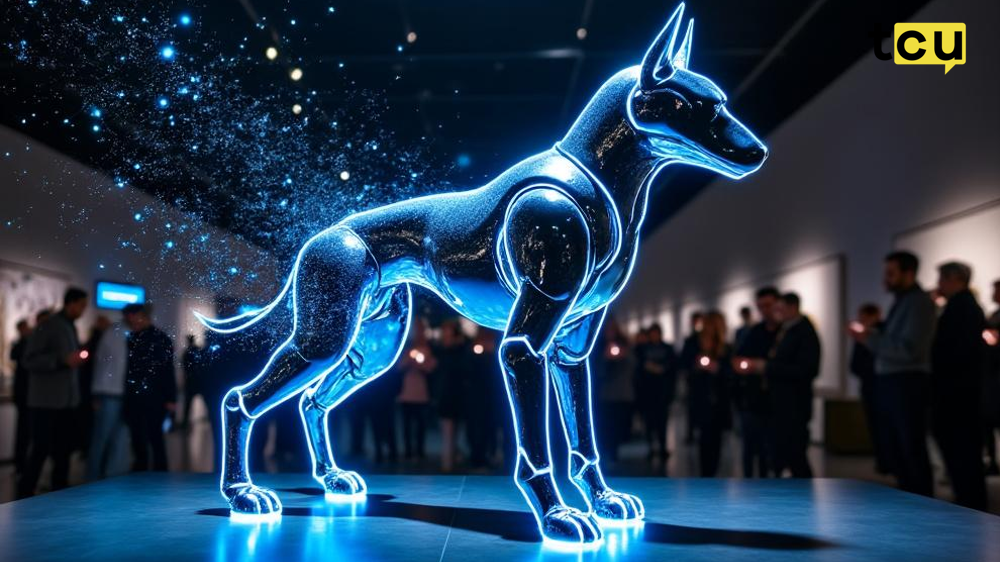
Beeple’s viral robot dogs at Art Basel
Beeple’s latest installation at Art Basel Miami Beach has become the talk of the art world this week. The digital artist, whose real name is Mike Winkelmann, created an interactive exhibit featuring Boston Dynamics-style robot dogs wearing oversized celebrity heads.
The robots moved through choreographed routines and then produced physical art prints that dropped to the floor. Each print was paired with a corresponding NFT, effectively turning the mechanical dogs into art-minting machines. Visitors could trigger the prints, collect them, and later claim the digital version.
What made the installation particularly interesting, I think, was the celebrity heads. The robots wore faces of Elon Musk, Mark Zuckerberg, Andy Warhol, and Beeple himself. The concept seemed to comment on how tech billionaires now shape our worldview in ways that artists once did.
The technology behind the art
The art generation process was surprisingly complex. AI algorithms within each dog selected the artwork, then ran it through various filters tied to famous artists before creating the final piece. This made the collection essentially generative art, though with a physical component that people could actually hold.
Crowds gathered constantly around the installation. Videos spread rapidly across social media platforms, and major art publications covered the exhibit extensively. It became one of the headline attractions at the entire Basel event.
Market response and significance
The market response has been strong. The Regular Animals NFTs now have a floor price around $35,000. That’s not quite the $69 million Beeple achieved with “Everydays: The First 5,000 Days” in 2021, but it’s still significant.
Some collectors and commentators are suggesting this might be Beeple’s most important NFT collection yet. Cozomo de Medici, a well-known NFT collector, posted on X that “Few works have sparked wonder like REGULAR ANIMALS by Beeple. These autonomous sculptures challenge all we think about perception, culture & influence.”
In an interview with the Wall Street Journal, Beeple explained his thinking. He noted that historically, artists like Picasso and Warhol changed how we see the world. Now, he suggested, tech giants like Musk and Zuckerberg shape our perception through their algorithms. The installation seemed to explore this shift, while also touching on how AI increasingly filters our reality.
What this means for digital art
Regular Animals demonstrates how digital art continues to evolve. The blend of robotics, satire, physical prints, and NFTs creates something that feels genuinely new. It’s not just digital art on a screen—it’s an experience that involves physical interaction and tangible objects.
Whether this marks another digital art renaissance, like the one Beeple helped start in 2021, remains to be seen. But the viral response suggests there’s still strong interest in innovative approaches to art and technology.
The installation raises questions about authorship too. With AI algorithms selecting and filtering the artwork, who exactly is the artist? Beeple designed the system, but the outputs are generated through automated processes. It’s an interesting tension that many digital artists are exploring right now.
For now, Regular Animals stands as a notable moment in this year’s art calendar. It shows that NFTs and digital art can still capture attention when executed with creativity and technical sophistication. The combination of physical and digital elements seems particularly effective—giving people something to experience in person while connecting to the blockchain world.